LMES Introduction
1. Product Overview
LMES (Line Manufacturing Execution System) is an AI-driven production line MES tool platform, built upon the mature and stable CMS platform. CMS is a new generation industrial SCADA (Supervisory Control and Data Acquisition) integrated management and control open platform born for equipment digitization business scenarios, driven by AI. LMES focuses on providing "process controllable, fully traceable, and autonomous" production line manufacturing execution solutions. As the core infrastructure for the digital transformation of manufacturing enterprises, LMES is committed to helping equipment companies achieve efficient and low-cost delivery of production line MES, assisting terminal factories in building data-driven high-efficiency, high-quality intelligent production lines, and realizing precise traceability of the full product life cycle.
Core Mission
With the AI-driven LMES tool platform as the core, through productized standard solutions, we promote manufacturing enterprises to achieve digital, standardized, and intelligent transformation and upgrading, and continuously improve production line capacity and yield.
Product Advantages
- Mature and Reliable: Verified by over 1000 production line MES projects, with a mature and stable technical architecture ensuring reliable system operation.
- Production Line Depth: Deep into the equipment layer, with powerful real-time data acquisition and control capabilities, accurately controlling process details.
- 100% Reliable Data: Architecture-level data assurance mechanism ensures zero data loss in abnormal scenarios such as production network fluctuations.
- Platform-based Open Architecture: Adopts a flexible "platform + application" architecture, providing out-of-the-box standard functions while supporting deep secondary development.
- Industry Expert Positioning: Deep understanding of manufacturing processes and quality management systems, with solutions built-in industry best practices.
- Deep Integration of AI Capabilities: AI technology is deeply integrated into the platform bottom layer, enabling intelligent generation of configuration pages and scripts, conversational data analysis and Q&A, significantly improving development efficiency.
1.1 Difference between Line MES and Traditional MES
As a focused application of MES on a single production line, the core differences between Line MES and Traditional MES (integrated system covering multiple workshops/entire factories) are reflected in five dimensions:
1. Management Scope and Granularity
Traditional MES: Covers workshops or the entire factory, integrates multi-line resources, focuses on global coordination, and management granularity is macro.
Line MES: Focuses on the full process of a single production line, management scope is limited to resources within the line, granularity is finer, focusing on local precise control and real-time anomaly response.
2. Functional Module Focus and Complexity
Traditional MES: Comprehensive and complex functions, requiring deep integration and cross-scenario collaboration, covering all links of factory-wide production management.
Line MES: Functions focus on the core needs of a single line, pruning and refining traditional functions, focusing on real-time monitoring and warning, in-line material management, line-level scheduling, and execution tracking.
3. Data Processing Real-time and Scale
Traditional MES: Balances real-time and global nature, large data scale, complex processing logic, processing cycle covers real-time - intermittent - periodic.
Line MES: Core is high real-time, relatively small data scale, concise processing logic, achieving second/minute-level response, focusing on immediate feedback and rapid decision-making.
4. Integration Depth with Other Systems
Traditional MES: Deeply integrates enterprise-level information systems, serving as a bridge for enterprise information architecture, realizing full-link information interaction.
Line MES: Integration scope focuses on systems related to a single line, docking upward with workshop-level systems or production planning modules, and downward with production line equipment control systems, with relatively low integration complexity.
5. Application Goal and Value Orientation
Traditional MES: The goal is to achieve transparent control and global optimization of production processes at the factory level, solving problems such as workshop system silos and non-shared data, improving factory-wide operational efficiency, reducing global costs, and meeting overall operational collaboration needs.
Line MES: The goal is to ensure the stable operation and maximization of local efficiency of a single production line, solving pain points such as slow real-time anomaly response, material mismatch, and long equipment downtime, improving single-line capacity and qualification rate, focusing on line-level optimization rather than factory-wide collaboration.
1.2 Functional Architecture Diagram
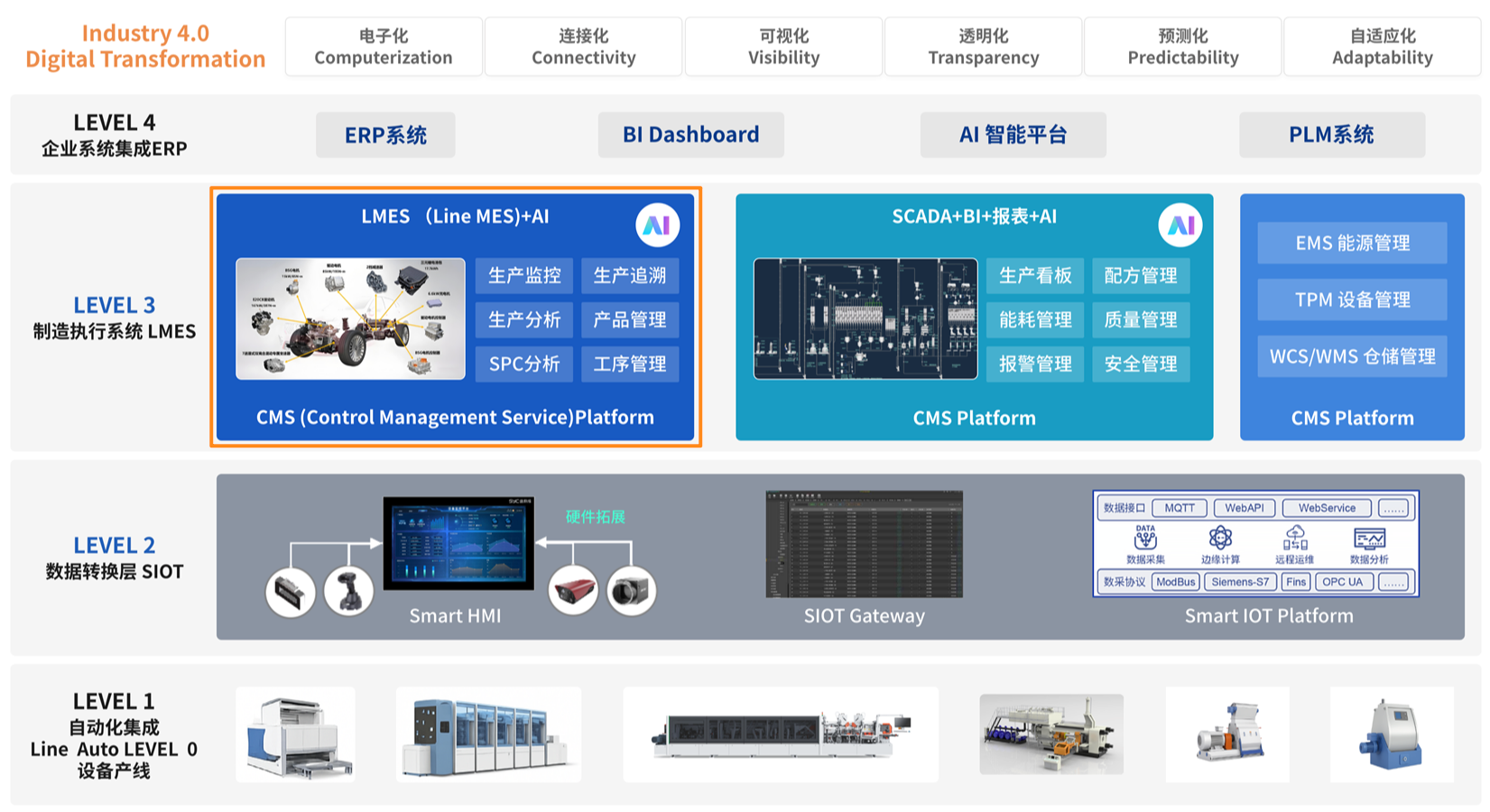
Positioning of LMES in Industry 4.0 Architecture
In the Industry 4.0 digital transformation architecture, LMES, as the "line-level intelligent brain", assumes the core functions of the manufacturing execution layer.
Architecture Level Positioning
LMES is located at LEVEL 3 - Manufacturing Execution System Layer, occupying a key position connecting the upper and lower levels in the entire Industry 4.0 architecture:
- Upper Connection: Docks with LEVEL 4 Enterprise System Integration Layer (ERP/BI Dashboard/AI Intelligent Platform/PLM System)
- Lower Connection: Collects equipment data through LEVEL 2 Data Conversion Layer (SIOT - Smart HMI/SIOT Gateway/Smart IOT Platform)
- Bottom Control: Finally controls the production line equipment of LEVEL 1/0 Automation Equipment Layer
This architectural positioning makes LMES a key hub connecting upper-level enterprise management decisions and bottom-level production equipment control.
Core Platform Foundation
LMES is built on the CMS Platform. CMS is a new generation industrial SCADA management and control integrated open platform driven by AI, providing strong underlying support for LMES, making it possess the following characteristics:
- Beyond traditional data recording systems, realizing active control of production processes
- Focusing on real-time line control and service-oriented management
- Deeply integrating AI technology, possessing intelligent analysis and decision-making capabilities beyond traditional MES
Six Core Functions
LMES provides six core functions: production monitoring, production traceability, production analysis, product management, SPC analysis, and process management, covering the full process control needs of line execution.
Seven Capabilities for Realizing Industry 4.0
LMES plays a key role in the evolution path of Industry 4.0, supporting the realization of six capabilities: Computerization, Connectivity, Visibility, Transparency, Predictability, and Adaptability, promoting manufacturing enterprises to transform from traditional production modes to intelligent manufacturing.
Differentiated Positioning from Other Systems
At the LEVEL 3 layer, LMES complements other systems:
- LMES: Focuses on the execution, control, and optimization of the Production Flow itself
- SCADA+BI+Report+AI: Focuses on data collection, analysis, and intelligent decision-making
- EMS/TPM/WCS/WMS: Focuses on energy management, equipment management, and warehouse management
As the core execution engine of intelligent manufacturing, LMES guarantees the high efficiency and high quality of the production process by integrating advanced technologies such as AI and data analysis, promoting manufacturing enterprises to achieve the leap from automation to intelligence.
1.3 Core Pain Points and Challenges
Manufacturing is moving from the era of experience-driven automation to the era of data-driven intelligence, but factories generally face the challenge of inaccurate and incomplete equipment and production data.
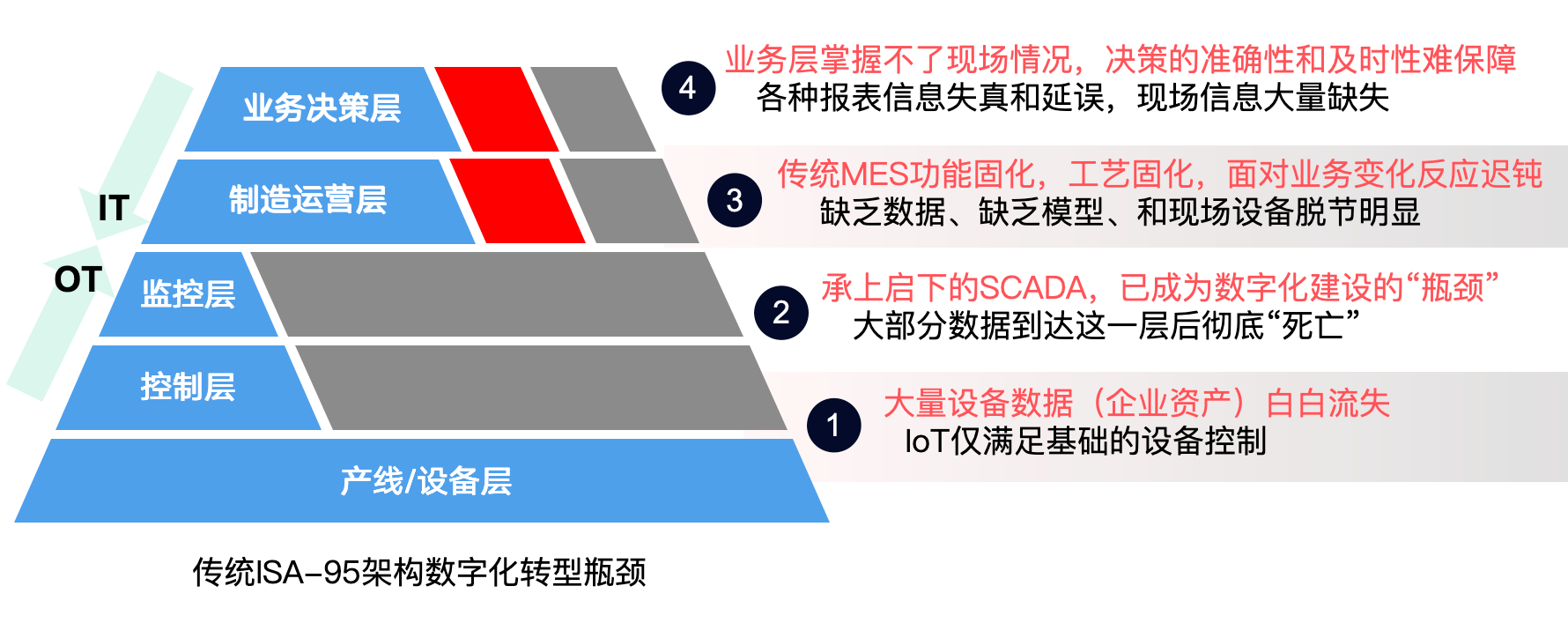
For Manufacturing Enterprises (EU)
- Insufficient autonomous control, difficult to carry out secondary development and operation based on business changes
- Lack of unified production line standards, cross-line replication and consistency are difficult to guarantee
- Supplier capabilities vary, delivery quality and stability are at risk
- Slow response to changes, high development and operation thresholds, uncontrollable costs and cycles
For Equipment Manufacturers (OEM)
- High self-research cost and cycle, great pressure on R&D resource investment
- High uncertainty in project-based delivery, frequent requirement changes lead to increased risks and costs
- Difficult project acceptance, lack of data-driven objective acceptance basis
- Limited system controllability, difficult to quickly locate and close on-site problems
- Difficult to gain insights from data analysis to feed back equipment design, unable to optimize equipment performance and reliability based on actual operating data
2. Product Value
As an AI-driven line MES tool platform, LMES helps manufacturing enterprises improve line capacity and yield through data-driven methods, providing comprehensive solutions and values:
For Manufacturing Enterprises (EU):
- Quality Control and Full Chain Traceability: Through digital tools, realize product data traceability, monitor quality indicators in real time, effectively prevent defective products from flowing out, and quickly locate the root cause of problems.
- Efficiency Improvement: Solve the challenge of flexible production on the production line, significantly improve production efficiency through more agile changeover execution.
- Autonomous Control: Provide an open platform and a complete set of development tools, allowing customers to independently carry out secondary development to meet future demand adjustment challenges.
- Data-Driven Optimization: Based on real-time production data analysis, continuously optimize production line operating parameters to improve capacity and yield.
For Equipment Manufacturers (OEM):
- Optimal Cost & Delivery Efficiency Improvement: Through standardized configuration delivery, improve project delivery efficiency and reduce the delivery cost of production line digitalization landing.
- Data-Driven Acceptance: Provide accurate data and visual dashboards to provide objective basis for project acceptance.
- Controllable Operation and Maintenance: Stable software architecture reduces later operation and maintenance risks.
- Data-Driven Design Optimization: Based on actual equipment operation data analysis, gain insights to feed back equipment design, continuously optimizing equipment performance and reliability.
2.1 AI Empowerment Scenarios
LMES deeply integrates AI capabilities into the platform, covering key links such as script development, page configuration, and data analysis, helping implementation and operation teams significantly improve delivery efficiency and quality.
Capability Overview
- AI Generated Dashboards and Reports: Based on data sources and indicator calibers, automatically generate configuration pages, charts, indicator cards, and filters; supports adjusting layout, chart types, and statistical dimensions using natural language, one-click publishing.
- AI Script and Third-Party Interface Development: Describe requirements in natural language, automatically generate interface scripts to dock with ERP/WMS/PLM, etc.; provide log audit and unit test templates.
- AI Assisted Programming: Turn requirements into code, generate frontend components, backend interfaces, and data models; automatically complete boundary conditions, produce unit tests, and provide refactoring suggestions.
- Chat BI (Conversational Data Analysis): Ask questions in natural language, automatically parse into queries and generate visualizations; support multi-source federal query, indicator caliber management, result interpretation and review, support exporting reports and subscription push.
Typical Applications
- Production Monitoring Dashboard Generation: Provide data sources, indicators, and role view requirements, AI generates the initial version of the configuration page; publish to the production environment after fine-tuning via natural language.
- Third-Party System Quick Docking: Describe interface goals and field mapping, AI generates scripts and test cases; verify in sandbox environment before going online, reducing integration workload.
- Quality Analysis and Problem Backtracking: Ask questions via Chat BI (e.g., "Shifts and reasons for abnormal welding process CPK in the last week"), AI returns charts and conclusions, along with reproducible query and caliber instructions.
3. Documentation Navigation
This document library provides comprehensive LMES system documentation, including user guides, development guides, quick starts, etc.
Main Document Categories
- Quick Start: Help new users quickly understand and get started with the LMES system.
- User Guide: Detailed introduction to the usage of LMES functional modules, including SOP management, SPC analysis, product management, etc.
- Development Guide: Provides API references, frontend and backend component development guides, and quick start tutorials.
- Advanced Guide: In-depth learning materials for advanced users.
- Video Tutorials: Provides video tutorials on system operation.
- Changelog: Records LMES system version update content.
- FAQ: Common problems and solutions during system use, helping you quickly locate and solve problems.
Quick Start
If you are using the LMES system for the first time, it is recommended to read the Quick Start document first, and then choose the corresponding User Guide or Development Guide according to your role and needs.
4. Demo Address
You can access the online demo of the LMES system through the following address:
- Demo Address: https://demo.syc-cms.com/
5. Contact Us
If you have any questions or needs, please contact our technical support team for help.